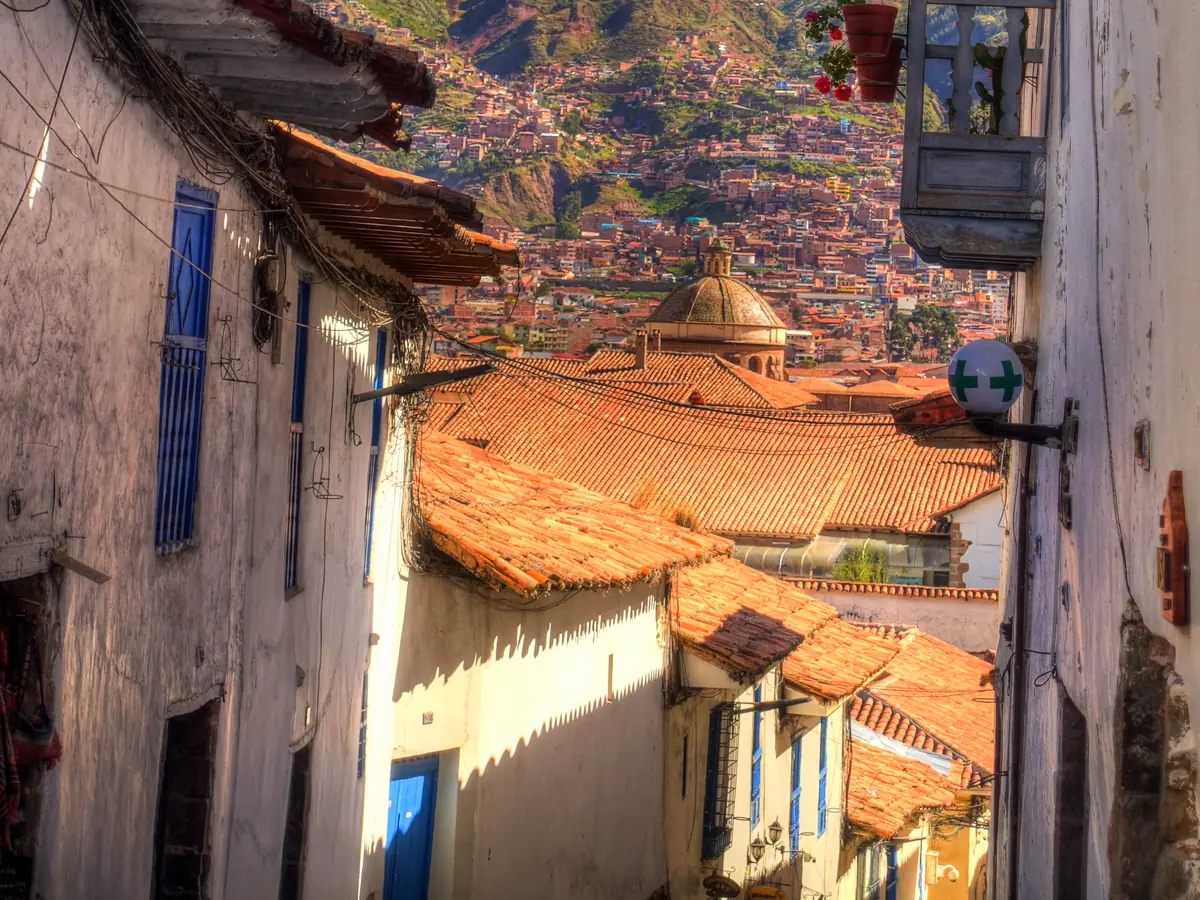
Cusco is easy to love and a little harder to read. The postcard version is real: Inca walls, red roofs, the Plaza de Armas at golden hour. But the city you live in during your first week also has honking taxis, buses named after superheroes, and a bin next to the toilet that nobody explained.
We see it all the time at our school on Calle San Agustín: students arrive on day one looking delighted and slightly baffled. So here are 19 curious facts about Cusco, with practical advice to go with them. None of these things is a problem, and all of them are easier once somebody tells you.
Cusco essentials at a glance
- Altitude: about 3,399 m (11,152 ft). Keep your first two days light.
- Taxis: no meters. Agree on the fare before you get in.
- Money: carry coins and small bills. The smallest coin is 10 céntimos.
- Bathrooms: paper goes in the bin. Bring tissues and a one-sol coin.
- Languages: Spanish everywhere, with plenty of Quechua woven through it.
Getting around Cusco: taxis, apps and buses
1. That honking car is probably a taxi
Taxis in Cusco don’t share one standard color, and many have no roof sign. If a car slows down beside you and taps its horn twice, the driver isn’t angry. They’re asking whether you want a ride.
Once you know this, the soundtrack of the city stops sounding hostile. It’s more like a very persistent job interview.
2. Taxis have no meter, so you agree on the price first
You say where you’re going through the window, the driver names a price, and you accept or suggest another. Short hops inside the historic center cost a few soles. For Velasco Astete airport, a street taxi or app ride usually falls somewhere between S/15 and S/40, depending on the hour and demand. Official airport counters tend to charge more.
Two habits make it painless: ask your host what the route should cost, and settle the fare before you sit down. Negotiating through a half-open window feels rude on day one and perfectly normal by day three.
3. Yes, you can use ride-hailing apps in Cusco
Uber, inDrive and DiDi have all reached the city. Fares are often a little lower than street taxis, and the app spares you the window negotiation, which is a relief when you’ve just landed and your Spanish is still warming up.
Airport pickups are the exception: some drivers will ask you to walk just outside the terminal. Cars also vary more than they do in Lima. Plenty of residents still prefer a street taxi from a rank they know, and both options are normal.
4. You might ride a bus called Batman
Private companies run Cusco’s bus routes and choose their own names. That’s how you end up boarding Batman, Zorro, Satélite or Rápido.
Several companies cover the same streets and compete for the same passengers, so a bus will occasionally sail past people waiting at a stop to overtake a rival. Don’t take it personally.
Expect to pay roughly S/1 to S/2 in cash to the cobrador, the conductor who leans out of the door shouting the main stops. Catching “¡San Blas, San Blas, San Blas!” at full speed is a listening exercise no textbook can match.
Money in Cusco: coins, cash and QR codes
5. The 1 and 5 céntimo coins are gone
Supermarket prices still end in 9.99 or 14.95, but you can’t pay those amounts exactly in cash. Peru’s central bank withdrew the 1 céntimo coin in 2011 and the 5 céntimo coin in 2019.
Today you’ll use coins of 10, 20 and 50 céntimos, plus 1, 2 and 5 soles.
6. Cash totals are rounded in your favor
Here’s the part visitors rarely hear. Under Peru’s consumer protection code, when a cash total can’t be paid exactly, the rounding must benefit the customer. A bill of S/5.99 becomes S/5.90, not S/6.00.
It’s pocket change, but you’re within your rights to mention it politely. Asking for your boleta, the consumer receipt, is completely routine.
7. Cash still beats cards in many places
Cards work well in hotels, supermarkets and larger restaurants. They’re far less useful at markets, street stalls, small menú restaurants and on buses.
Break your big bills whenever you get the chance. A S/200 note is very hard to change at a market stall.
8. Everyone pays by QR code, except most visitors
From taxi drivers to the person selling emoliente on the corner, everyone seems to use Yape or Plin. Sadly, they’re rarely practical on a short trip, because you generally need a local bank account or card and an accepted ID. If you’re staying for months, ask a bank about the current requirements.
Food in Cusco: when words don’t mean what you think
9. “Carne” doesn’t always include chicken
Tell a waiter you don’t eat carne and they may cheerfully offer you chicken instead. In everyday use, carne often means red meat, and pollo is its own category. Don’t assume that fish is covered either.
The safest sentence names all three: “Soy vegetariano/a. No como carne, ni pollo, ni pescado.” It prevents an astonishing number of misunderstandings.
10. Cuy really is on the menu
The guinea pig is a pet in much of the world and a celebration dish in the Andes, where people have raised it for thousands of years, long before chicken or beef arrived.
It usually comes whole, head and feet included. Nor is it everyday food: think birthdays, patron saint festivals and special Sunday lunches. To try it, skip the terraces on the Plaza de Armas and look for a traditional restaurant in Tipón or a quinta in San Jerónimo.
11. The best smell in the street is anticuchos
That smoke around 6 p.m.? Beef heart marinated with vinegar, garlic and ají panca, grilled on skewers and often served with a boiled potato and a piece of choclo, Andean corn. The ají sauce is optional in theory and always there in practice.
Anticuchos are cheap and excellent. Choose a stall with a line and a busy grill.
12. You can ask for a little extra: the yapa
When you buy fruit or bread at the market, you can ask for the yapa, a small extra on top. The word comes from the Quechua yapay, to add. Say it with a smile to your casera, the vendor you always go back to, and you may leave with one more tangerine.
Everyday life in Cusco: what nobody warns you about
13. Toilet paper goes in the bin
Nearly every bathroom has a small bin beside the toilet, and that’s where the paper goes. Older pipes are narrow, water pressure can be low, and paper blocks them.
Many public toilets have no paper at all, and some charge a sol. Carry tissues and a coin. It may be the most useful tip in this whole article.
14. A green light doesn’t always mean go
When the little green figure appears, look both ways anyway. Turning cars often claim the right of way, whatever the signal says.
Do what locals do: cross with a group, make eye contact with the driver and keep a steady pace. Stopping in the middle is the one thing that doesn’t work.
15. There’s a tiny kiosk on almost every corner
Cusco’s sidewalk kiosks are packed from floor to ceiling with sweets, chips, drinks and phone credit. They open early and close late, so you rarely have to plan ahead for a bottle of water.
16. Walls double as billboards
Coca-Cola, Inca Kola and Claro appear in enormous letters painted straight onto houses. Political parties do the same, and their logos linger for several elections, slowly fading.
On the road to the Sacred Valley, you can read layers of Peruvian political history on a single adobe wall.
17. Old VW Beetles refuse to retire
Most cars in Cusco are Asian imports, but you’ll still spot old Beetles in every color, kept alive with impressive mechanical optimism. Ask a Cusqueño about the escarabajo and you’ll usually get a story.
18. Cusco is higher than Machu Picchu, and you’ll feel it
At about 3,399 m (11,152 ft), Cusco sits nearly 1,000 meters above Machu Picchu. If you fly in from sea level, you may get breathless on the stairs, have a mild headache or sleep badly for a night or two. Locals call it soroche.
A gentle start helps:
- Rest on your first day and save Rainbow Mountain for later in the trip.
- Stay hydrated and eat light meals.
- Skip alcohol for the first 24 to 48 hours.
- Try mate de coca if you like. It’s offered everywhere, and many people find it helps with mild symptoms.
- Wear sunscreen even under gray skies. The UV is fierce up here.
Know the warning signs: confusion, repeated vomiting or breathlessness at rest need medical attention right away. Tea won’t fix those.
19. The Spanish you hear is full of Quechua
This one is our favorite, because it changes how the whole city sounds. Papa, choclo, palta, cancha, chacra, pampa, chullo, yapa: all of them come from Quechua. So does the city’s name, Qosqo, traditionally explained as “navel” or “center.”
Then come the local habits. Ahorita can mean in one minute or later today. Ya covers yes, okay, sure and finally. Vendors may call you casera or casero, and diminutives like un ratito, un poquito and aquicito soften almost any request.
Quechua is a living language here, and a greeting goes a long way. Try one of these at the market and watch the conversation warm up:
| Quechua | English |
|---|---|
| Rimaykullayki | Hello |
| Allillanchu? | Are you well? |
| Allillanmi | I’m well |
| Sulpayki | Thank you |
Why learning the language changes your stay
Spanish opens the country. Quechua opens Cusco. You can study Spanish with us in private or small-group lessons, or go further with the Intensive Spanish Course. Our Quechua course is taught one-to-one, with basic Spanish as the bridge language.
Much of what you’ve just read comes up in class, usually because a student walks in with a story about a bus called Batman. For places to explore after lessons, see our guide to Cusco and its surroundings.
Frequently asked questions about Cusco
Is Cusco safe for tourists?
The historic center is generally safe, and tourist police patrol it. Pickpocketing does happen on crowded buses and in busy markets, so keep valuables secure and take a taxi instead of walking alone late at night.
Does Uber work in Cusco?
Yes. Uber, inDrive and DiDi all operate in Cusco, alongside street taxis. Airport pickup arrangements vary by app and driver.
Why does toilet paper go in the bin in Peru?
Narrow pipes and low water pressure, especially in older buildings, mean that paper can block the plumbing. Most bathrooms have a bin for it.
How high is Cusco, and will I get altitude sickness?
Cusco is about 3,399 m (11,152 ft) above sea level. Mild symptoms are common on arrival. Rest on day one, stay hydrated, avoid alcohol and allow at least two days before any strenuous trek.
Can tourists use Yape or Plin in Peru?
Usually not on a short trip. You generally need a local bank account or card and an accepted ID, so most visitors use a mix of cash and cards.
Do I need cash in Cusco?
Yes. Cards work in hotels and larger restaurants, but you’ll need cash for buses, street food, small entrance fees and most market stalls. Carry small bills and coins.
Is guinea pig (cuy) commonly eaten in Cusco?
It’s a traditional celebration dish rather than everyday food. You’ll find it at birthdays, festivals and Sunday lunches, usually served whole.
Ready to hear Cusco for yourself?
Tell us when you’re coming and how much Spanish you speak, even if the answer is none. We’ll help you find the right course, and soon those two beeps will make perfect sense.